After success in the US, BMW brings humanoid robots to assembly lines in Europe
After a resounding success in the United States, the BMW Group is bringing the concept of “Physical AI” to European soil. The Leipzig plant becomes the Bavarian manufacturer’s first production facility in Europe to integrate multifunctional humanoid robots for the assembly of critical components such as high-voltage batteries.
LEIPZIG, Germany – The automotive industry is undergoing a radical transformation, and the line between science fiction and assembly line reality is becoming increasingly blurred. The BMW Group has officially announced the launch of a new pilot project at its Leipzig plant, where state-of-the-art humanoid robots will work side by side with human employees. The move marks a first for the brand’s European production facilities and comes as a natural evolution after rigorous tests conducted overseas last year.
Spartanburg Legacy: Success Figures
The foundation of this project was laid in South Carolina, at the Spartanburg plant. There, over the course of 10 months, the humanoid robot Figure 02 demonstrated that the technology is mature for heavy industrial environments. The statistics are impressive:
- 30,000 BMW X3s were assembled with the help of robots.
- Over 90,000 sheet metal components were handled with millimeter precision.
- The robots worked in 10-hour shifts, taking the equivalent of 1.2 million steps.
Although Figure 02 proved to be a model "worker", tests in the US also revealed the limits of the current architecture, prompting the engineering team to seek even more versatile solutions for the challenges in Europe.
Leipzig and the new "colleague": The AEON robot
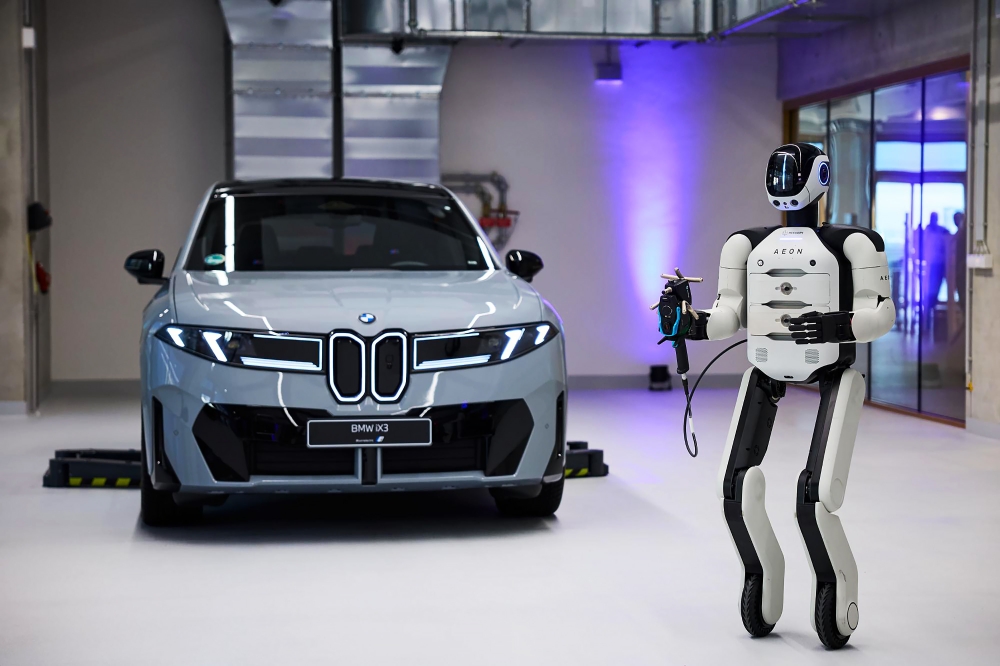
While Spartanburg relied on a bipedal design (with legs), for the Leipzig plant, BMW opted for a strategic collaboration with its long-term partner, Hexagon. The new protagonist of the German factory is the AEON robot, officially presented in the summer of 2025.
Unlike its predecessors, AEON combines a humanoid torso and arms with a mobile wheeled base, providing superior stability and speed in the tight spaces of the factory. It is equipped with advanced scanning systems and a modular range of “hands” and clamps, and is designed to be multifunctional.
Mission: High-precision batteries and components
In Leipzig, the robots' main focus will be on assembling high-voltage batteries for electric models. It's a task that requires extreme precision, but also involves safety risks or difficult ergonomic requirements for humans (such as wearing heavy protective equipment).
“Digitalization and physical artificial intelligence (Physical AI) allow us to completely rethink the production flow,” said Milan Nedeljkovi?, Member of the Board of Management of BMW AG. “It is not about replacing people, but about freeing them from repetitive and physically demanding tasks, while improving our global competitiveness.”
Implementation schedule
The Leipzig project is not just a technology demonstration, but a long-term integration plan:
- December 2025: The first laboratory tests and theoretical evaluations were successfully completed.
- April 2026: A new phase of testing directly on the production line will begin to calibrate the sensors under real-world conditions.
- Summer 2026: Official launch of the full pilot phase, where AEON robots will become an integral part of the series manufacturing process.
A new era: "iFACTORY"
This initiative is part of the BMW iFACTORY strategy, the brand's vision for "lean, green and digital" production. By integrating humanoid robots that can learn and adapt to changes on the line, BMW is joining other giants such as Tesla and Hyundai in the race for the "factory of the future."
For the workers in Leipzig, AEON's presence means better working conditions and the opportunity to focus on quality control and complex systems management, leaving the "low-level work" to algorithms and steel arms. The future of the automobile is no longer built with fixed keys, but with neural networks and state-of-the-art sensors.