Electric Car Boom and Major Balance Shifts in April 2026
While hybrid powertrains maintain their supremacy, traditional gasoline and diesel models are losing ground at an accelerated pace. The Renault Group and Dacia are experiencing a difficult period of contraction.
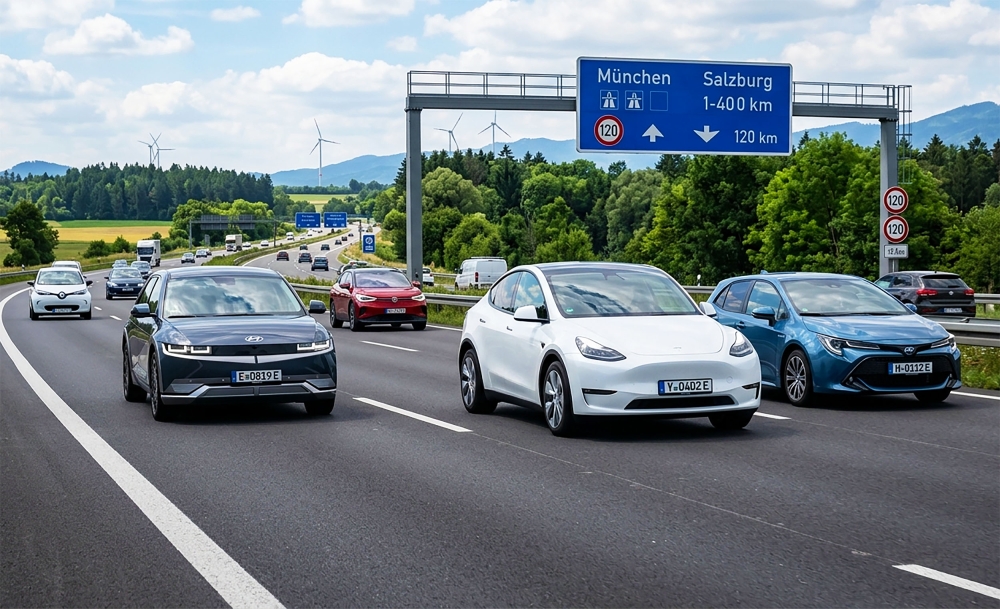
BRUSSELS – The European automotive market is undergoing a profound structural transformation, marked by an accelerated shift away from traditional powertrains and the rapid consolidation of low-emission vehicles. According to the latest data published by the European Automobile Manufacturers' Association (ACEA), new car registrations increased by 7% in April 2026 at European level. This development was driven by a meteoric rise of over 38% in sales of fully electric cars, a dynamic that places battery-powered vehicles just one step away from definitively dethroning gasoline engines.
In the second month of spring, Europeans purchased a total of 1,152,315 new cars. The indicator cumulates volumes achieved in the European Union member states, in the EFTA member countries (Iceland, Liechtenstein, Norway, Switzerland) and in the United Kingdom. The growth rate indicates a solid resilience of the continental market, stimulated by the diversification of electrified offers and the adaptation of tax subsidy schemes in the major economies.
Reconfiguring propulsion systems: Hybrids dominate, gasoline and diesel lose ground massively
A detailed look at fuel options highlights a historic reconfiguration of customer preferences. Models powered by alternative technologies are becoming the new industry standard, while classic fossil fuels are experiencing severe declines.
- Hybrid Electric Vehicles (HEVs): They remain the number one choice on the continent. With 419,556 units sold in April, this category marked a +12.7% increase over the same period last year, providing a safety zone for users in transition.
- Gasoline engines: Although they barely maintain their second position in the top of preferences, their market share has visibly eroded. Sales fell by -14.8%, falling to 255,902 units.
- 100% Electric Vehicles (BEV): Represents the big surprise of April, reaching a record volume of 255,296 units — a tiny gap of only 606 units behind gasoline. The spectacular growth of +38.3% reported in April 2025 reconfirms a clear acceleration curve of the massive adoption of electric propulsion.
- Plug-in Hybrid (PHEV) systems: Continue to play a key role in the technology-neutral decarbonization strategy, reaching a volume of 118,645 units sold (+20.3%).
- Diesel engines: Emphasizing a steep decline that seems irreversible. Diesel technology attracted only 77,806 customers across Europe, marking a collapse of -17.3%.
The balance sheet of the first four months of 2026: The trend is consolidating
April's performance is not an isolated case, but validates the macroeconomic trends of the year. Between January and April 2026, Europeans purchased a total of 4,672,775 new cars, equating to an overall increase of +4.8% compared to the first four months of 2025.
The long-term structural dynamics show a stable growth of hybrids (+11.7%) and a solid rise of the pure electric segment (+29.1%). In the mirror, the decline of conventional engines stabilizes around the same percentages in both fossil fuel segments: sales of gasoline cars fell cumulatively by -16.5%, while diesel cars contracted by -16.7%.
Top car manufacturers: Volkswagen and Stellantis advance; Renault and Dacia lose speed
The official ACEA report also highlights notable discrepancies in the performance of large industrial groups competing for market shares.
- The Volkswagen Group maintains its position as the absolute leader in the European market. The German conglomerate reported 266,139 cars delivered in April (+3.2%) and surpassed the historic milestone of one million vehicles in the first four months (1,013,771 units, up +2.9%).
- Stellantis secures its second position and reports one of the strongest growth rates among traditional manufacturers. With 159,147 vehicles sold in April (+5.5%) and 648,354 units since the beginning of the year (+7.8%), the group validates its multibrand commercial strategies.
- The Renault Group, in third place, is going through a period of correction in delivered volumes. The French recorded a decrease of -4.3% in April (98,055 units) and a more pronounced contraction of -7.4% in the first four months of the year (384,256 vehicles).
- Dacia unfortunately follows the same downward curve as its parent group. The brand delivered 42,219 units in April, marking a decrease of -4.1% compared to April 2025. The pressure was felt more acutely in the cumulative period January - April 2026, where Dacia totaled 157,628 new cars, which represents a significant compression of -15.3% in volumes compared to the same period last year.
A turning point for the automotive industry
ACEA data for the first four months of 2026 clearly demonstrates that Europe's ecological transition is no longer just a legislative aspiration, but a clear commercial reality. The fact that electric cars have reached volumes almost identical to gasoline cars indicates that a market inflection point is imminent. For volume manufacturers like Dacia, rapidly adapting the portfolio to new demand dynamics and accelerating the launch of affordable electrified models represent major strategic challenges for the rest of 2026.