The sound that breaks the silence barrier: Skoda launches DuoBell, the doorbell that "tricks" noise-canceling headphones
In a world where cities are becoming increasingly quiet due to noise-canceling technology, Skoda is returning to its origins as a bicycle manufacturer to solve a modern and dangerous problem: the "digital deafness" of pedestrians.
The history of the Skoda brand did not begin with an engine under the hood, but with a chain and two pedals. 131 years ago, in Mlada Boleslav, the foundations of what was to become an automotive giant were laid. Today, the Czech manufacturer proves that it has not forgotten its "first love", but that it looks at it through the lens of 21st century technology.
The Silence Trap: When Music Becomes a Road Hazard
Accelerated urbanization has brought with it a major shift in the street hierarchy. In London, for example, statistics show that this year the number of cyclists will exceed that of drivers for the first time. But this victory for green mobility comes at a cost: a 24% increase in collisions between cyclists and pedestrians reported in 2024.
The unexpected culprit? Active Noise Cancelling (ANC) headphones. While they help us escape the stress of the city, these devices filter out background noise so effectively that they make traditional audible warnings “invisible.” A pedestrian immersed in their favorite podcast simply can’t hear the tinkling of a regular doorbell.
DuoBell Technology: How to Trick an Algorithm
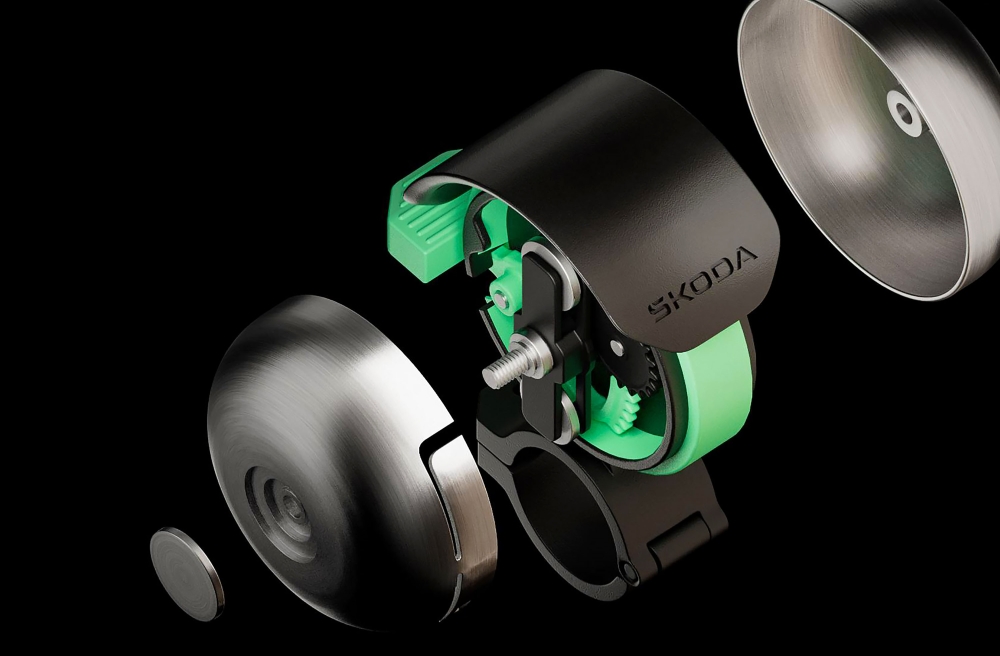
To break this wall of silence, Skoda teamed up with acoustic experts from the University of Salford. The result is DuoBell, a device that looks like a simple doorbell but hides precision engineering.
Researchers have discovered that most ANC systems have a vulnerable spot: an extremely narrow frequency band, between 750 and 780 Hz, that manages to penetrate digital filters almost constantly.
"DuoBell doesn't just ring, it strategically communicates with the headphones' algorithms," the specialists explain.
The innovation consists of:
- Second resonator: Tuned to the "golden" frequency that cannot be canceled.
- Irregular striking mechanism: DuoBell produces rapid, asymmetrical strikes. This irregularity misleads the headphone software, which cannot identify the sound as "repetitive background noise" and eliminate it.
Seconds that save lives
Tests conducted in real traffic conditions have revealed sobering figures. A pedestrian wearing ANC headphones has, on average, a 5-second longer reaction time to a classic doorbell than an optimized one. At normal driving speed, this means a 22-meter longer reaction distance — often the difference between a scare and a serious accident.
With the DuoBell project, Skoda not only confirms its status as a supporter of cycling (already visible through partnerships with the Tour de France and La Vuelta), but also underlines a philosophy of safety that goes beyond the car's interior. In a future where cities will be dominated by bicycles, the most important accessory may not be a more powerful electric motor, but a bell that knows how to make itself heard through the "noise" of silence.
Verdict: Skoda proves that road safety is not just about parking sensors and automatic braking, but also about understanding how technology changes our perception of reality. DuoBell is essentially a "safety update" for real life.